2021
Launched through the federal Budget
Origin
Created as part of Budget 2021 investments in a more equal Canada.
Research & community awareness
Improving how justice data is collected and used — to understand and reduce the overrepresentation of Indigenous, Black, and racialized people in Canada’s justice system.
01 / Definition & context
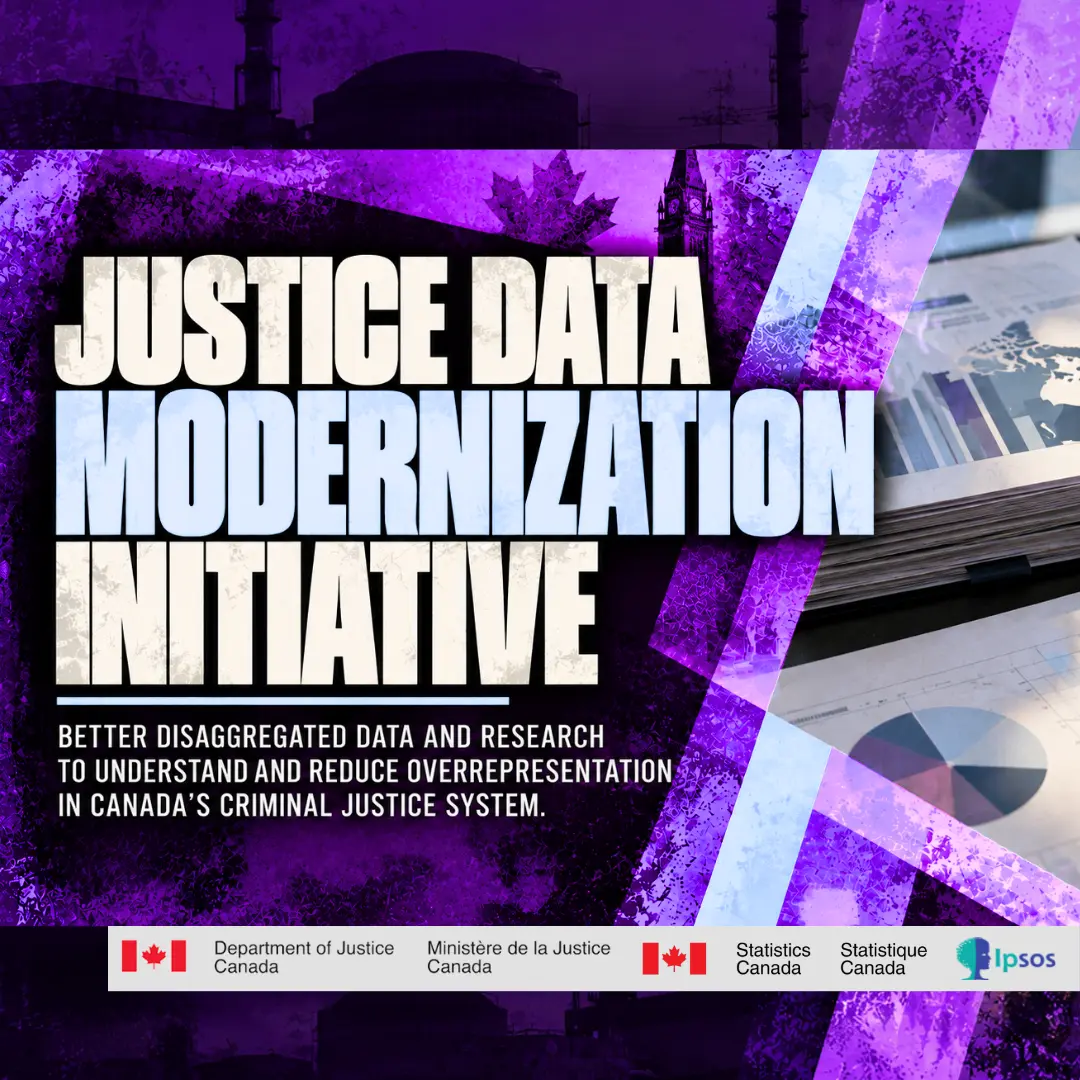
The Justice Data Modernization Initiative (JDMI) improves the collection and use of disaggregated data to address the overrepresentation of Indigenous, Black, and racialized people in the criminal justice system.
Led by Justice Canada and Statistics Canada, it was created as part of Budget 2021 investments in a more equal Canada. It recognizes that involvement with the justice system is often influenced by broader social factors — education, economic opportunity, health, community supports, and experiences of discrimination.
Because of that, the initiative invests in research that helps identify the programs, supports, and interventions that contribute to positive outcomes for youth and communities.
Disaggregated data is data that has been divided into smaller groupings, often based on population characteristics — supporting fair and inclusive decision-making.
02 / Objectives
The JDMI aims to give decision-makers and communities the evidence they need to prevent crime and victimization and to reduce overrepresentation — with action that reaches beyond the justice system.
2021
Origin
Created as part of Budget 2021 investments in a more equal Canada.
2
Justice Canada · Statistics Canada
Working alongside provinces, territories, and community partners.
3
Research · Measurement · Collaboration
Commissioned research, a national measurement framework, and community-led study.
Summarized from the Department of Justice Canada’s Justice Data Modernization Initiative page.
Provide governments and communities with stronger data and evidence on the programs and policies that prevent crime and victimization and reduce the overrepresentation of Indigenous, Black, and racialized people.
Support cross-sectoral, collaborative, and tailored action that invests in people and communities, rather than relying on the justice system alone.
Recognize that action within the criminal justice system alone is not enough, and that involvement with the system is shaped by broader social factors such as education, economic opportunity, health, and experiences of discrimination.
Disaggregated data is data that has been divided into smaller groupings, often based on population characteristics. It supports fair and inclusive decision-making.
The initiative responds to a long-standing need for more disaggregated data and innovative research to inform policy responses to overrepresentation.
Statistics Canada is working with federal, provincial, and territorial governments and other stakeholders on a national framework for measuring overrepresentation in the criminal justice system, so progress can be monitored over time.
03 / How it works
The work is carried out through research, measurement, and collaboration.
Justice Canada and Statistics Canada lead complementary streams, and external researchers and community-led organizations shape the work so it reflects the people it is meant to serve.
Research & Statistics Division
Commissions and conducts research on overrepresentation, including the role that social sectors, governments, and communities can play in supporting well-being and reducing criminalization.
National framework
Works with federal, provincial, and territorial governments and other stakeholders on a national framework for measuring overrepresentation in the criminal justice system, in order to monitor progress.
Community partnership
Carried out with external researchers, academics, and organizations led by Indigenous, Black, and racialized communities, so the work reflects many perspectives and lived experience.
04 / Community research
As part of the JDMI’s goal of understanding what contributes to positive outcomes for youth and communities, Statistics Canada, Justice Canada partnered with IPSOS and YAAACE to explore the outcomes and impacts of YAAACE programming and to identify approaches for measuring them over time.
The partnership
An approved Statistics Canada microdata-linkage project links YAAACE participant information with policing, criminal court, corrections, and demographic data to assess socioeconomic outcomes and subsequent interactions with the criminal justice system.
05 / Partners & approach
The initiative brings together federal partners, provinces and territories, and community-led organizations, and draws on both in-house and external research.
Leads the initiative, commissions and conducts research, and summarizes findings to support evidence-based policy, programs, and legislation.
Develops the national framework for measuring overrepresentation and carries out approved microdata-linkage projects.
Collaborate on shared measurement and on cross-sectoral action that reaches beyond the justice system.
Indigenous, Black, and racialized community organizations help shape and carry out research so it reflects lived experience.
Conducted by Research & Statistics Division researchers inside the Department of Justice.
Conducted by contracted specialists, including academics, community-based researchers, and legal experts, to draw on many perspectives.
06 / Wider research
The JDMI sits within the work of the Research & Statistics Division.
The Division supports evidence-based decisions on justice issues, summarizing its findings in reports and data products. These are published and open to all.
Short summaries of key research and data on justice issues.
Visit (opens in a new tab)A comprehensive analysis of how Canada’s criminal justice system is performing.
Visit (opens in a new tab)Examines the legal problems people in Canada face and how they try to resolve them.
Visit (opens in a new tab)Tracks Canadians’ perceptions and knowledge of justice issues each year.
Visit (opens in a new tab)Legal aid revenues, expenditures, application volumes, and client demographics.
Visit (opens in a new tab)Research on the needs of victims of crime and how to respond to them.
Visit (opens in a new tab)07 / Read further
Explore the official pages and data behind the initiative. Research questions can be directed to the Research & Statistics Division at rsd-drs@justice.gc.ca.
Department of Justice Canada
The initiative’s official page, including its objectives and components.
Department of Justice Canada · opens in a new tabDepartment of Justice Canada
The Research & Statistics Division’s research, reports, and data products.
Department of Justice Canada · opens in a new tabDashboard & reports
Data and reporting on how Canada’s criminal justice system is performing.
Department of Justice Canada · opens in a new tabStatistics Canada
National statistics on crime and the justice system.
Statistics Canada · opens in a new tab