4.3%
of Canada’s population identified as Black
2021 Census
A population baseline for understanding representation.
Education & community awareness
Addressing anti-Black racism. Changing the systems that shape justice. Supporting the people and communities affected.
01 / Definition & context
Canada’s Black Justice Strategy aims to address anti-Black racism and systemic discrimination that contribute to the overrepresentation of Black people in the criminal justice system, including as victims of crime.
The Strategy responds to longstanding research and the experiences of Black communities. Its scope reaches beyond the justice system to the social conditions that influence people’s contact with it.
The external Steering Group’s Roadmap sets out recommendations. The government’s Implementation Plan describes a phased response over 10 years.
Anti-Black racism is harming families and communities and is costing Canada the valuable contributions of Black people across our nation.
02 / The evidence
The presentation describes disparities in justice, public safety, and economic opportunity. These measures cover different years and populations.
4.3%
2021 Census
A population baseline for understanding representation.
9%
2022–2023
The presentation compares this with a 4% share of the adult population.
13%
2024
Approximately 102 of the 788 victims reported in the presentation.
22.6%
July 2026 · reported in the presentation
The presentation describes a rate roughly double that of non-racialized, non-Indigenous youth.
Figures reported in the supplied presentation. Reference years are shown with each measure; these are not a single current-year comparison.
Justice Canada’s 2020–2021 national engagement process included Black youth aged 18–29 reflecting on experiences at ages 12–17, alongside families and stakeholders across six cities, including Toronto. The presentation cites Jeffers and Owusu-Bempah (2021).
The report describes a “revolving door” of custody. Young people reported stigma, limited rehabilitation, and insufficient reintegration support after release. The presentation identifies over-policing and offences linked to survival or identity as two pathways shaped by anti-Black racism.
Young people described unmet financial needs, family responsibilities, and systemic exclusion from the labour market as factors drawing them into criminalized activity.
Arrests rose from 41 during January–July 2022 to 107 in the same period in 2024, an increase of approximately 161%. Adult firearm arrests rose 2% over that period. This measure concerns Toronto youth overall, rather than a Black-youth-specific arrest count.
The presentation reports national Black unemployment at roughly 1.7–2 times the overall rate, citing 11.1% versus 6.4% in the 2026 State of Black Economics Report and a separate 11.8% measure from 2021 Census analysis. It also reports that 15% of Canadian youth, or 376,000 people, were not in education, employment, or training in 2017–2018. Of those youth, two-thirds were not looking for work and one-third were actively seeking work. These measures cover different populations and years.
The presentation cites Deloitte/The King’s Trust Canada (2024): unaddressed youth unemployment could cost Canada $18.5 billion in GDP and $5.3 billion in government revenue by 2034.
Presentation-derived estimate: applying a 5.6% Black youth population share produces approximately $1.04 billion in GDP and $297 million in revenue. This is a proportional calculation in the presentation, rather than a separate forecast for Black youth.
Black people accounted for 6% of accused adults and youth, compared with a 3% population share at the time. The presentation cites Justice Canada’s 2022 JustFacts summary.
Black people accounted for 20% of people accused of homicide. The reported rate was 8.17 per 100,000, compared with 1.43 for non-racialized people.
The reported homicide victimization rate for Black people was 7.72 per 100,000, compared with 1.81 for non-racialized people, approximately four times higher.
The presentation reports approximately 102 Black victims among 788 homicides nationally, citing Statistics Canada (2025).
Presentation-derived estimate: applying a societal cost of $4.8–$5.9 million per homicide gives approximately $490–$602 million, expressed in 2014 dollars. This is a calculation based on the cost range attributed to Public Safety Canada.
The presentation describes rising homicide in lower-income, majority-Black neighbourhoods over the preceding decade and limited access to survivor and bereavement supports. It does not provide a dated dataset for this neighbourhood-level claim.
Black people represented 39% of those involved in use-of-force incidents, compared with 10.2% of Toronto’s population, according to the presentation.
Black people represented 9% of the federal offender population, compared with approximately 4% of the national adult population.
The presentation reports Black people as 18% of offenders in custody in the region. At one maximum-security institution, it reports 41% of offenders identified as Black, compared with 2% of front-line correctional officers and no front-line parole or program officers. The slide does not specify the reference year.
Black and Indigenous offenders were placed in higher security levels on admission at twice the average rate of other offenders, according to the finding cited in the presentation.
The presentation reports that 85.8% of Black offenders were not readmitted to federal custody within five years of sentence expiry. It contrasts that result with assessments of higher risk and lower reintegration potential. The slide does not specify the cohort or reference year.
03 / History
A United Nations recommendation, a federal mandate, and community consultation shaped the Roadmap and Implementation Plan.
The UN Working Group of Experts on People of African Descent visits Canada.
The Working Group recommends a strategy to address the overrepresentation of Black people in the justice system.
Canada formally recognizes the UN International Decade for People of African Descent, 2015–2024. The presentation identifies Canada as the first OECD country to do so.
The Prime Minister’s mandate letter directs the Minister of Justice to create Canada’s Black Justice Strategy.
Justice Canada establishes a group of nine experts and leaders from Black communities to develop the Framework and Roadmap.
Twelve Black-led organizations lead consultations. Justice Canada runs a complementary online survey.
A Roadmap for Transformative Change sets out 114 recommendations.
The UN General Assembly adopts the Second International Decade for People of African Descent, 2025–2034, co-sponsored by Canada.
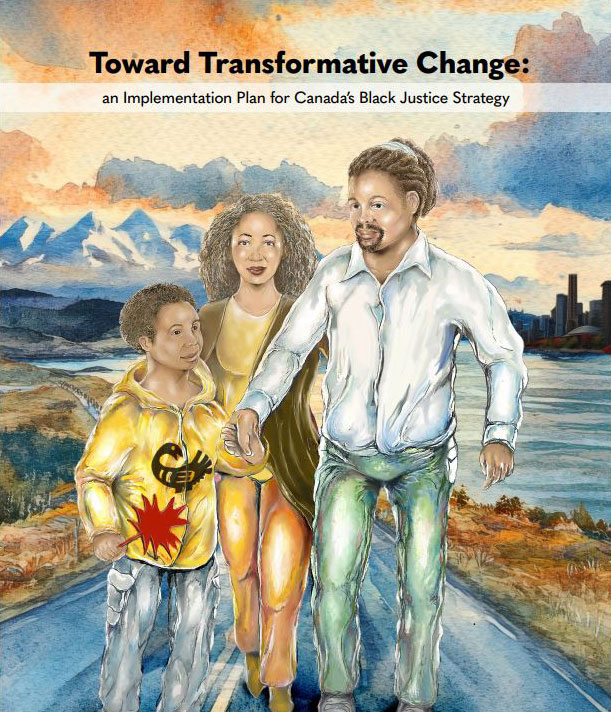
Then-Minister of Justice Arif Virani releases Toward Transformative Change, the government’s 10-year implementation plan.
04 / Authors & consultation
Black community experts and leaders developed the Framework and Roadmap. Twelve Black-led organizations led consultations during September and October 2023, alongside Justice Canada’s online survey.
The external Steering Group
Established by Justice Canada in February 2023. The presentation names these nine contributors, including a former member.
05 / The Roadmap
106 of the Roadmap’s 114 recommendations sit within five pillars.
These areas reflect how Black people experience the justice system and the wider conditions that shape those experiences. The remaining eight recommendations address accountability across the system.
Recommendations 9–33
Address the conditions that shape people’s lives before contact with the justice system.
Recommendations 34–42
Address racial profiling and strengthen accountability in police practices.
Recommendations 43–85
Reform laws and court processes to improve fairness and access to justice.
Recommendations 86–103
Improve correctional practices and access to culturally responsive rehabilitation.
Recommendations 104–114
Support people returning to their communities and reduce repeated contact with the justice system.
06 / Cross-cutting recommendations
The Roadmap’s first eight recommendations propose structural changes that reach across, and beyond, the five pillars. These are recommendations, rather than a list of completed government actions.
Establish a department or agency to coordinate government-wide efforts to advance the interests of Black people in Canada.
Create a dedicated Department of Justice portfolio to reform laws and policies that disproportionately affect Black people.
Establish a Public Safety Canada division focused on crime prevention tailored to Black communities.
Endow an independent research, policy, and advocacy institute with funding for 50 years.
Create a Statistics Canada unit to coordinate data across policing, courts, corrections, and reintegration.
Reduce incarceration rates for Black and Indigenous people by 50%, and the overall rate by 30%, relative to population share, as described in the Roadmap summary.
Legally recognize Black people as a distinct group in Canada to enable targeted policies and programs.
Mandate anti-Black racism and cultural competency education for federal employees, with extension to provinces and territories.
07 / The Implementation Plan
The 2024 Fall Economic Statement proposed $276.4 million as a first step in the government’s 10-year commitment.
The initial allocations begin in fiscal year 2025–2026. Most run over two years; the $189 million Black Entrepreneurship Program allocation runs over five years.
Proposed initial investment
$276.4M
Across the five pillars
Starting in 2025–2026Read the funding details (opens in a new tab)Canadian dollars, millions · amounts shown in the presentation
Multiple federal departments · Allocations over two and five years
Royal Canadian Mounted Police · Over two years
Department of Justice Canada · Over two years
Correctional Service Canada · Over two years
Public Safety Canada · Over two years
The chart amounts total $276.5M. The presentation and official Implementation Plan state $276.4M overall. The $0.1M difference is retained rather than silently adjusted.
Timing and breakdown from the official Implementation Plan. All allocations begin in 2025–2026.
Justice Canada coordinates the Strategy. Public Safety Canada and its portfolio agencies deliver initiatives within three of the five pillars.
Leads the Strategy and coordination across nine federal departments and agencies, with provincial and territorial collaboration.
Proposed over two years, starting in 2025–2026
Partners with Black-led and Black-serving organizations on support after release.
Proposed over two years, starting in 2025–2026
Supports an Anti-Racism Unit and reform of national policing practices.
Proposed over two years, starting in 2025–2026
Supports the Black Offender Strategy and culturally responsive rehabilitation.
Proposed over two years, starting in 2025–2026
$42.8M is the combined proposed investment for Public Safety Canada, the RCMP, and Correctional Service Canada across policing, corrections, and reintegration.
08 / Read further
Explore the original recommendations, implementation commitments, and voices that informed the Strategy.
The Roadmap · June 2024
The external Steering Group’s report, including all 114 recommendations.
Department of Justice Canada · opens in a new tabThe Implementation Plan · February 2025
The Government of Canada’s plan for responding to the Roadmap over 10 years.
Department of Justice Canada · opens in a new tabConsultations & supporting publications
Community consultation reports, survey findings, and the Strategy’s Framework.
Department of Justice Canada · opens in a new tab
Source material: Canada’s Black Justice Strategy V3, the supplied presentation. This page summarizes its content and links to official publications. Statistics retain the presentation’s dates and attributions; calculated estimates are identified separately.